

More Connecticut Students Prepared for College and Careers
Press Releases

10/27/2026
State Accountability Results Show Continued Gains in Academic Achievement and Graduation Rates; 138 Schools Recognized for High Performance and Growth
(Hartford, CT) – Connecticut students are making continued progress in academic achievement, attendance, graduation rates, and preparation for college and careers, according to new statewide accountability results released today by the Connecticut State Department of Education (CSDE).
The results are part of Connecticut's Next Generation Accountability System, first implemented in 2014–15. The system measures school and district performance across 12 indicators, going beyond test scores and graduation rates to provide a more complete picture of how schools support student learning, growth, and well-being.
The results show improvement in most areas measured by the state's Next Generation Accountability System, including:
- Academic achievement: Students continued to improve in English language arts, mathematics, and science.
- Attendance: Chronic absenteeism declined for the fourth consecutive year.
- Graduation: More students graduated within four years, while more ninth-grade students remained on track to graduate on time.
- College and career readiness: More students entered postsecondary education and demonstrated readiness for education and training beyond high school.
- Student well-being and engagement: Results also improved in physical fitness and participation in the arts.
“These results reflect the hard work of Connecticut’s students, educators, families, local board members, school and district staff, and communities, along with the continued commitment of state and local leaders to strengthening public education across our state,” said Education Commissioner Charlene M. Russell-Tucker. “We are encouraged by the progress across multiple measures of student success, particularly the significant increase in students earning college credits while still in high school, giving them a head start on their future, whether they pursue workforce certificates and credentials or two- or four-year college degrees. Through strategic investments and strong partnerships, we are empowering every learner’s journey by building on students’ strengths, encouraging them to explore their interests, and opening doors to new possibilities.”
138 Connecticut Schools Recognized for Excellence and Improvement
The CSDE recognized 138 schools across Connecticut as Schools of Distinction for demonstrating high academic performance, significant improvement, or strong student growth. These schools are recognized for their success in helping students achieve academically, making meaningful progress toward closing achievement gaps, and supporting students with high needs.Among the 138 recognized schools, 28 are located in Alliance Districts, which receive targeted state support to help improve student outcomes. Their recognition highlights the progress being made in school communities throughout Connecticut.
Statewide Trends in Next Generation Accountability Results
|
Indicator |
2018-19 |
2021-22 |
2024-25 |
2025-26 |
|
|
1a. |
ELA Performance Index – All Students (avg achievement) |
67.7 |
64.2 |
64.7 |
65.0 |
|
1b. |
ELA Performance Index – High Needs Students (avg achievement) |
58.1 |
54.2 |
54.9 |
55.4 |
|
1c. |
Math Performance Index – All Students (avg achievement) |
63.1 |
58.6 |
61.1 |
61.7 |
|
1d. |
Math Performance Index – High Needs Students (avg achievement) |
52.7 |
47.7 |
50.6 |
51.3 |
|
1e. |
Science Performance Index – All Students (avg achievement) |
63.8 |
61.4 |
62.6 |
63.1 |
|
1f. |
Science Performance Index – High Needs Students (avg achievement) |
54.2 |
51.3 |
52.1 |
52.6 |
|
2a. |
ELA Avg. Percentage of Growth Target Achieved – All Students |
59.9% |
60.4% |
60.6% |
59.3% |
|
2b. |
ELA Avg. Percentage of Growth Target Achieved – High Needs Students |
55.1% |
56.2% |
55.7% |
54.8% |
|
2c. |
Math Avg. Percentage of Growth Target Achieved – All Students |
62.5% |
65.2% |
62.3% |
60.9% |
|
2d. |
Math Avg. Percentage of Growth Target Achieved – High Needs Students |
55.2% |
59.1% |
55.9% |
54.0% |
|
2e. |
Progress Toward English Proficiency – Literacy |
60.0% |
64.9% |
58.7% |
59.0% |
|
2f. |
Progress Toward English Proficiency – Oral |
52.1% |
57.4% |
55.7% |
53.9% |
|
4a. |
Chronic Absenteeism – All Students |
10.4% |
23.7% |
17.2% |
16.4% |
|
4b. |
Chronic Absenteeism – High Needs Students |
16.1% |
34.0% |
24.8% |
23.8% |
|
5 |
Postsecondary Preparation |
80.0% |
84.8% |
92.4% |
94.1% |
|
6 |
Postsecondary Readiness |
42.6% |
43.5% |
47.2% |
49.9% |
|
7 |
On-track to High School Graduation |
88.0% |
82.7% |
85.9% |
87.7% |
|
8 |
4-year Graduation - All Students |
88.3% |
89.6% |
88.9% |
91.2% |
|
9 |
6-year Graduation - High Needs Students |
83.3% |
85.2% |
87.3% |
85.8% |
|
10 |
Postsecondary Entrance* |
70.9% |
66.1% |
67.0% |
67.4% |
|
11 |
Physical Fitness |
52.9% |
45.8% |
49.0% |
50.4% |
|
12 |
Arts Access |
51.9% |
52.4% |
55.1% |
56.4% |
|
|
Accountability Index |
74.2 |
69.7 |
71.8 |
72.2 |
*Postsecondary Entrance data are provided by the National Student Clearinghouse and represent the values at thetime of the original data match conducted one year after high-school graduation. Prior-year values may differ slightly when updated in subsequent years.
More Students are Earning College Credits While Still in High School
More than one-third of Connecticut students in Grades 11 and 12 are now earning at least three college credits while still in high school, helping them get a head start on college and reduce the cost of earning a degree. The percentage of students earning three or more college credits with a grade of C or better increased from 22.3 percent in 2021–22 to 34.6 percent in 2025–26, which represents more than 9,700 additional students earning college credits over that four-year period. Research from the U.S. Department of Education’s Institute of Education Sciences shows that dual-credit programs have positive effects on college enrollment and degree attainment, reinforcing the importance of expanding these opportunities for Connecticut students.
Percentage of Grade 11 and 12 Students Earning Three or More College Credits

Every student group experienced growth in college credit attainment during this period, including significant gains among students with high needs, Hispanic/Latino students, and Black/African American students:
• High Needs: 12.8% -22.4%
• Hispanic/Latino: 14.0%- 24.8%
• Black/African American: 14.5% -26.4%
Through these opportunities, students can earn college credits before graduating from high school, reducing future college costs and helping them build confidence as they prepare for education and careers beyond high school. Most courses are offered at high schools and taught by instructors approved by partnering colleges and universities.
Beginning in 2023–24, the CSDE invested nearly $4 million in school districts and $5 million in colleges and universities to expand access to these opportunities. The CSDE also strengthened partnerships between high schools and higher education institutions to offer courses aligned with students' interests and future career opportunities.
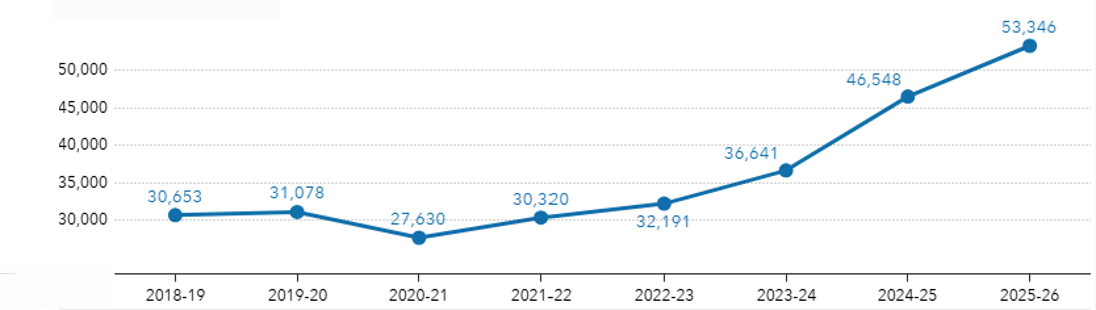
These dual credit opportunities have expanded the number of college-level courses completed by Connecticut high school students by more than 70 percent, from 30,653 in 2018–19 to 53,346 in 2025–26.
Dual Credit Courses Completed
Dual Credit Courses Completed by College Sector

To build on this progress, Governor Ned Lamont and the General Assembly have provided $6 million in new state funding to help cover the cost of college-level courses for high school students and expand course offerings across Connecticut. While the University of Connecticut's Early College Experience (ECE) program continues to account for the largest share of these courses statewide, participation through the Connecticut State Universities has grown nearly tenfold since 2018–19.
Examining Postsecondary Readiness
In addition to earning college credits, students can demonstrate readiness for college-level work by meeting established benchmarks on the SAT, ACT, Advanced Placement (AP), or International Baccalaureate (IB) exams. Nearly half of Connecticut students in Grades 11 and 12 now meet at least one of these college readiness benchmarks, up from 43.5 percent in 2021–22 to 49.9 percent in 2025–26. This is the highest level recorded since Connecticut introduced its current accountability system in 2014–15.
Improvements were seen across almost every student group, including substantial gains among students with high needs, Hispanic/Latino students, and Black/African American students:
- High Needs: 21.2% - 30.1%
- Hispanic/Latino:23.7% - 33.9%
- Black/African American:21.0% - 33.2%
The percentage of students meeting the AP exam benchmark also improved from 23.0 percent in 2021–22 to 30.0 percent in 2025–26. To help ensure these opportunities are accessible to all students, the CSDE continues to provide funding to cover AP exam fees for students from low-income families.
Targeted Support for School Improvement
As part of its ongoing efforts to improve student outcomes, the CSDE has identified 72 schools to receive additional state support this year. These include 40 Turnaround Schools, which receive comprehensive assistance to improve overall school performance, and 32 Focus Schools, which receive targeted support to address specific areas needing improvement.
All 72 schools are eligible to apply for federal school improvement funding to help strengthen teaching, learning, and student supports. Additionally, seven previously identified schools demonstrated sufficient improvement to no longer require this designation.
For complete accountability results, including lists of Turnaround Schools, Focus Schools, and Schools of Distinction, visit the CSDE’s Next Generation Accountability Dashboard.
Looking Ahead
The 2025–26 results demonstrate continued progress. Through ongoing collaboration among educators, families, community partners, and district and state leadership, the CSDE is building on evidence-based strategies—such as dual credit expansion, attendance improvement, and equitable access to rigorous coursework—to ensure that every student is prepared for success in college, career, and life. The examples below are organized by the CSDE’s 2025–26 Focus Areas.
Elevate curriculum frameworks and curricula
- Providing free access to high-quality K–8 model curricula and 9–12 courses, instructional resources, and aligned professional learning.
- Supporting 130 teacher leaders through the Curriculum Teacher Leader Fellowship, a statewide professional learning opportunity focused on developing and implementing local systems, practices, and policies for high-quality curriculum.
- Advancing Connecticut’s comprehensive literacy strategy, grounded in the Right to Read legislation, through more than $24 million invested in K–3 literacy assessments and instructional materials, and $15 million in professional learning for educators and leaders statewide, including the Science of Reading Masterclass.
- Investing $2 million in a statewide literacy coaching initiative to provide job-embedded support to K–3 educators in identified schools, while leveraging a five-year, $10 million federal grant to expand targeted reading intervention for K–3 students experiencing significant reading difficulties across a statewide network of 75 elementary schools.
- Establishing Connecticut’s first Educator Competencies for Structured Literacy and Dyslexia, which set research-aligned expectations for the knowledge and practices educators need to effectively teach reading and writing.
- Providing approximately 300 short interim block assessments in ELA, mathematics, and science at no cost to districts to monitor student learning throughout the year and support instruction.
- Investing an additional $2 million in high-dosage tutoring following nearly $11.5 million in mathematics tutoring investments that improved academic outcomes for participating students.
Recruit and retain a diverse workforce
- Investing $6 million through the Aspiring Educators Scholarship Program to provide scholarships of up to $10,000 annually to eligible students enrolled in approved educator preparation programs in Connecticut.
- Investing $2 million in partnership with the Connecticut Department of Labor to continue a teacher Registered Apprenticeship Program to provide aspiring educators with an earn-while-you-learn pathway that combines educator preparation with paid, hands-on classroom experience.
- Expanding Grow Your Own educator pathways, including Educators Rising and Next-Gen Educators, to introduce students to careers in education and build a more diverse pipeline of future Connecticut educators.
- Supporting beginning educators through the Teacher Education and Mentoring (TEAM) Program, which provides mentorship and professional learning to strengthen educator development and retention.
- Investing $1 million to launch the new Paraeducator Preparation Academy, which removes barriers for aspiring paraeducators by providing free training, study materials, exam fees, mentorship, and Spanish-language support.
Ensure students are physically present and engaged, support a safe and healthy learning environment
- Implementing the evidence-based Learner Engagement and Attendance Program (LEAP), and expanding to include alternative education programs, through a $7 million state investment to support home visits that strengthen family-school relationships and improve student attendance and engagement.
- Convening educators, school staff, community partners, and school leaders through Talk Tuesdays to share practical, research-based strategies for improving student attendance and engagement.
- Investing approximately $20 million in grants to 92 school districts to support the delivery of school-based mental health services for students during school years 2023 through 2026.
- Providing approximately $8 million in grants to 84 districts and summer camp programs to support the delivery of mental health services for students during the summer months.
- Investing more than $13 million in grants to provide summer enrichment opportunities to children during the summers of 2023 and 2024.
- Providing actionable data through EdSight Secure, including longitudinal information and early warning metrics that help authorized district staff identify students who may need additional support.
- Launching the “No Matter What” campaign to highlight resources available to support regular school attendance for students experiencing homelessness and housing instability.
- Reaching students and families through the “School is Better with You” campaign to promote school attendance, which generated 59 million online impressions and delivered attendance awareness materials and toolkits to more than 110 districts.
Modernize and expand postsecondary pathways
- Investing $3.8 million in 89 school districts and nearly $5 million in public and private institutions of higher education through the Dual Credit Expansion Grant to increase opportunities for students to earn college credit while in high school.
- Providing $6 million in new state funding to offset the cost of dual credit courses and programs for Connecticut students and support the expansion of new course offerings.
- Investing nearly $1 million to help high-need students access postsecondary readiness opportunities, including Advanced Placement and International Baccalaureate exams, dual credit courses, industry-recognized credentials, and the Seal of Biliteracy.
- Establishing a statewide registry of more than 300 industry-recognized credentials in collaboration with education, workforce, and business partners to support career pathways aligned with real-world job opportunities.
Improve outcomes for all students, with a focus on students with disabilities
- Implementing a statewide individualized education program (IEP) Quality Initiative that provides comprehensive professional learning and technical assistance to educators and school leaders to strengthen IEP quality, implementation, and compliance, and improve outcomes for students with disabilities.
- Expanding special education leadership supports through executive coaching, the Planning and Placement Team Institute, the Aspiring Leaders Cohort, and the IEP Quality Leadership Module.
- Strengthening statewide dyslexia and structured literacy efforts through the Dyslexia Awareness Campaign, continued training and professional learning, and an additional $500,000 state investment in the Office of Dyslexia and Reading Disabilities.
- Investing $30 million in Special Education Enhancement Grants and an additional $40 million through the special education excess cost formula to strengthen supports for students with disabilities.
- Awarding $10.6 million to 41 programs through the High-Quality Special Education Incentive Grant Program to strengthen and expand in-district and regional programming for students with disabilities.
###
CONTACT INFORMATION:
Matthew Cerrone
matthew.cerrone@ct.gov
- Twitter: CT State Department of Education Twitter
- Facebook: CT State Department of Education Facebook
Legal Disclaimer:
EIN Presswire provides this news content "as is" without warranty of any kind. We do not accept any responsibility or liability for the accuracy, content, images, videos, licenses, completeness, legality, or reliability of the information contained in this article. If you have any complaints or copyright issues related to this article, kindly contact the author above.
